
I wrote this guide to help you check your prostate health at home. It shows when to see a doctor. We talk about symptoms, at-home PSA tests, and tracking methods.
This guide is not a replacement for doctor advice. If you’re in the U.S., see your primary care or urology for concerns.
The prostate is a small gland below the bladder. Cancer starts when cells grow too much. Important tests are the PSA blood test and the DRE.
In the U.S., doctors first check you, then send you to a urologist. You might get a PSA test, MRI, and biopsy.
This article is for men over 40 and those with a family history of prostate cancer. It’s also for anyone interested in checking for prostate cancer at home. Remember, home checks need lab tests and doctor exams to confirm.
Key Takeaways
- Home checks help track symptoms and decide when to see a clinician.
- Know basic terms: PSA is a blood marker; DRE is a clinical exam.
- At-home PSA kits exist, but abnormal results need lab confirmation.
- Men over 40 and those with family history should monitor more closely.
- Timely clinical follow-up improves chances for effective treatment.
How to check for prostate cancer at home
I explain simple ways men can monitor prostate health from home. These methods can flag concerns early. But, they do not replace laboratory tests or a doctor’s exam.
Overview of at-home screening vs clinical screening
At-home tools include symptom checklists, symptom-tracking apps, urine tests, and at-home PSA kits. These tools give preliminary information. They help detect prostate cancer at home when used correctly.
Clinical screening uses lab-based PSA, a digital rectal exam (DRE), multiparametric MRI, and biopsy. Clinical tests are diagnostic. They combine imaging, tissue sampling, and lab measurements for higher sensitivity and specificity than most DIY prostate cancer test options.
I recommend thinking of home methods as triage. They help decide when to seek full prostate screening in a clinic. Single at-home results should prompt follow-up, not a final diagnosis.
When at-home checks are appropriate and when to see a doctor
At-home checks work well for routine symptom monitoring. They are useful for tracking changes between visits. They are also good for men who feel anxious about an office visit.
See a primary care doctor or urologist if symptoms worsen. An abnormal at-home PSA or a strong family history also requires a visit. Prompt evaluation matters when changes are persistent or sudden.
Safety and limits of home-based detection
Home tests can give false positives and false negatives. A DIY prostate cancer test may cause anxiety if results are unclear. Relying only on direct-to-consumer tools can delay diagnosis and treatment.
Regulatory status matters. Choose FDA-cleared kits when available and follow instructions for specimen handling and privacy. Improper collection, storage, or interpretation can invalidate results and risk your health.
| Method | Typical use | Strength | Key limit |
|---|---|---|---|
| Symptom checklist / apps | Routine monitoring | Low cost, easy tracking | Subjective, cannot diagnose |
| At-home PSA kit | Preliminary PSA level | Convenient, can trigger clinic visit | Variable accuracy vs lab test |
| Urine biomarker test | Research or supplemental screening | Noninvasive, emerging utility | Not all tests are FDA-cleared |
| Clinical PSA + DRE | Diagnostic screening | High reliability with follow-up | Requires clinic visit and sometimes imaging |
When symptoms, an abnormal at-home PSA, or a notable family history appear, contact your provider. Proper handling of specimen kits and clear communication with the lab protect your privacy and improve result value.
Common early warning signs of prostate cancer to watch for
I want to help you spot changes that matter. Not every symptom means cancer, but tracking patterns makes it easier to decide when to get checked. A routine prostate cancer self-exam and a regular prostate health self check can guide conversations with your doctor.
I’ll break signs into three groups you can monitor at home. Note onset, how often symptoms happen, and what makes them better or worse. Log dates and severity to share during visits. Family history, like a first-degree relative with prostate cancer, raises your risk and lowers the threshold to seek evaluation.
Urinary symptoms
I track changes in frequency, like more trips to the bathroom at night. A weak or interrupted urinary stream, trouble starting or stopping, a sense of incomplete emptying, urgency with dribbling, or sudden retention are all worth noting. These signs overlap with benign prostatic hyperplasia and infections. If they appear rapidly or worsen with a fever, call your provider.
Pain and discomfort
Watch for new pelvic pressure, steady low back or hip pain, or pain in the perineum. Pain during ejaculation is another red flag. Persistent or progressive skeletal pain may signal advanced spread and needs prompt assessment. Don’t ignore ongoing pain that changes your daily activity.
Systemic signs
Unexplained fatigue, appetite loss, and unintended weight loss can be subtle clues. Hematuria, or blood in the urine, deserves immediate attention. These systemic signs are less specific on their own but become concerning when they happen with urinary changes or pain.
I recommend a simple logging approach I use with patients: note the symptom, date, severity on a 1–10 scale, triggers, and any relief measures tried. This makes a prostate cancer self-exam or a formal clinic visit more productive.
| Sign category | Common symptoms | When to seek care |
|---|---|---|
| Urinary | Frequent urination, nocturia, weak stream, urgency, incomplete emptying | If new, progressive, or accompanied by fever or inability to urinate |
| Pain | Pelvic pressure, low back/hip pain, perineal pain, painful ejaculation | Persistent or worsening pain, specially if it limits activity |
| Systemic | Fatigue, appetite loss, unexplained weight loss, blood in urine | Any hematuria or unexplained weight loss with other symptoms |
What tools and products can help with home prostate screening
I search for tools that are easy, reliable, and tested by labs. At-home PSA test kits are now more accurate. They use a fingerstick or dried blood spot to send to a lab.
Some need a small urine sample or use a quick test for fast results. Results come in 2–7 days when sent to a lab. Quick tests give yes or no answers but not exact numbers.
At-home PSA test kits and how they work
These kits come with easy-to-follow steps, lancets, and a return envelope. You prick your finger or give a urine sample. Then, you send it to a lab for testing.
Labs test the sample and give you a number. Blood spots stay good if mailed fast. Some services offer quick calls to talk about your results.
Digital apps and symptom trackers for prostate health
I track symptoms to see if they change. Apps help you log how often you pee, pain, and more. They show trends over time.
Make sure the app is safe and follows privacy laws. A good app helps you get ready for doctor visits and share your health info.
Reliable brands and where to buy (pharmacies, online retailers)
I look for brands that share lab info and support details. Everlywell and LetsGetChecked offer accurate home tests. Walgreens and Amazon sell these kits too.
Be careful of “free test” offers. Make sure they are real and include good care. Look for FDA approval, easy instructions, and good customer service.
How to use an at-home PSA test kit safely
I help patients use at-home testing safely. This way, they feel confident and avoid mistakes. A clear routine is key when testing for prostate cancer at home.
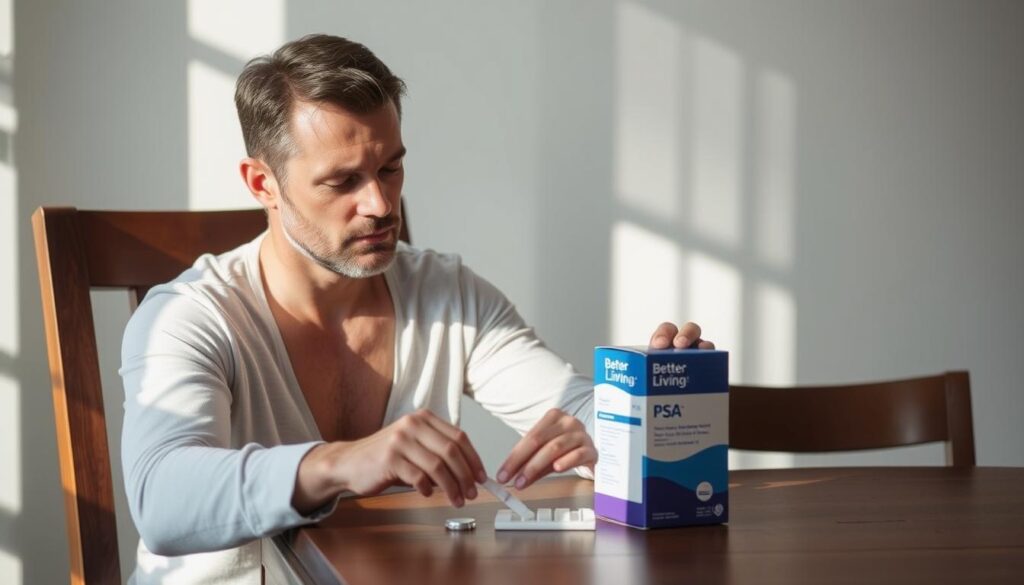
Step-by-step sample collection and handling
First, register the kit online or fill out the form inside. Then, wash your hands well before starting.
Follow the steps for a fingerstick or urine sample. For a blood card, prick your finger and collect drops until the circles are full. Let the card dry in the air.
For a urine sample, collect the first urine after a few hours. Seal swabs or cards as told and include the paperwork with the lot number and date.
Avoid ejaculation for 24–48 hours before testing. Don’t test if you have a urinary tract infection. If you take finasteride or dutasteride, tell your doctor.
Interpreting PSA results and understanding ranges
PSA numbers need context. A PSA above 4.0 ng/mL used to raise concern. But age is important.
Free-to-total PSA ratio and PSA density help estimate risk. A rapid rise in PSA over time is more important than a single high value.
One high home PSA is not a diagnosis. If your result is abnormal, call your doctor or urologist for more testing and evaluation.
Common errors to avoid when using home kits
- Insufficient blood volume or incomplete urine sample that yields an unreadable result.
- Contamination from poor hand hygiene or touching collection areas.
- Improper labeling or missing paperwork that delays processing.
- Delays in shipping; long transit times can degrade samples.
- Collecting after vigorous exercise, recent catheterization, or prostate manipulation like a recent digital rectal exam.
- Failing to report medications, recent infections, or procedures that affect PSA.
I suggest documenting the kit lot number, collection date, and result. Keep a photo or scanned copy for your medical record. If results are abnormal, contact your clinician quickly and provide this documentation during follow-up. Doing a prostate cancer self check or a prostate exam at home can be useful when done carefully and paired with professional care.
How accurate are at-home PSA tests and other DIY methods
I look at how home PSA kits and DIY tests compare to doctor’s office tests. I start with a quick overview, then compare the methods. I also talk about what can change the results and what studies say.
Comparison to lab-based PSA testing and DRE
Lab tests are the gold standard for PSA. Home kits that send samples to labs are pretty accurate. But, following the instructions is key for good results.
Digital rectal exams are also important. They can find things that PSA can’t. I think of DRE and PSA as working together, not alone.
Factors that affect accuracy: infection, medication, age
Many things can change PSA levels. Infections or recent exercise can raise it. Some medicines can lower it.
Age and race also play a part. African American men might have different PSA levels. Watching how PSA changes over time is helpful.
Evidence on at-home PSA test accuracy and studies
Studies show home kits can be very accurate if done right. But, mistakes in collecting the sample can mess up the results.
Most studies see home PSA as a good screening tool. But, it’s not a final say on health.
| Method | Typical Setting | Strengths | Limitations |
|---|---|---|---|
| CLIA lab venous PSA | Clinic or hospital lab | Gold-standard accuracy; low preanalytical error | Requires phlebotomy and clinic visit |
| At-home kit with CLIA lab processing | Kit collection at home, courier or mail to lab | Convenient; comparable accuracy if handled correctly | Vulnerable to collection and transport errors |
| Fingerstick rapid strip (point-of-care) | Home or pharmacy | Fast results; user-friendly | Lower analytic sensitivity; more variance |
| DIY prostate cancer test (symptom check, urine dip) | Home self-assessment | Accessible; raises awareness | Not diagnostic; high false-positive and false-negative risk |
If your home PSA test shows something odd, get a blood test at a lab. Wondering about the accuracy of at-home tests? Talk to your doctor about what to do next.
Understanding advanced at-home tests and biomarkers
I explain how urine and blood biomarkers help when PSA or DRE results are unclear. These tests aim to refine risk. This way, fewer men have to get biopsies they don’t need. They also help find serious disease.
Below, I talk about the ExoDx approach. I also summarize published evidence and reviews of the exodx prostate test. Plus, I compare other molecular prostate tests and urine-based home tests you might hear about.
ExoDx Prostate test score explained
The ExoDx Prostate (EPI) or IntelliScore is a urine test. It looks at ERG, PCA3, and SPDEF biomarkers in urine. You don’t need a digital rectal exam before the test.
The test gives a score that shows how likely you are to have serious prostate cancer. A low score means you’re less likely to have high-grade disease. This might mean you don’t need a biopsy right away.
A high score means you might have a higher risk. Your doctor might want to do a biopsy or more tests. Remember, the score is just one part of the puzzle. Your doctor will look at your PSA, age, family history, and MRI results too.
What the ExoDx reviews and data say about effectiveness
Studies show ExoDx can help avoid unnecessary biopsies. It also helps find serious cancers. Men with unclear PSA results often find it helpful.
ExoDx has clinical data to back it up. But, coverage by insurance varies. Always check if your insurance covers it before getting the test.
Other molecular and urine-based home tests
There are many molecular prostate tests out there. Each uses different biomarkers and samples. PCA3 is a urine test for prostate cancer RNA, usually ordered by a doctor.
SelectMDx looks at HOXC6 and DLX1 in urine to predict aggressive cancer. PHI and 4Kscore are blood tests that combine PSA forms and kallikrein markers. Oncotype DX Prostate analyzes tumor genes from a biopsy to predict cancer aggressiveness. It’s not a home test.
Some tests are for direct-to-consumer use, while others need a doctor’s order. Always check if a test is meant for a doctor’s office or for home use before getting it.
When advising someone, I stress important points. Ask your urologist how the test score would change your care. Check insurance coverage and costs. Make sure the test is available in your area. These steps help make decisions based on evidence and what’s best for you.
| Test | Sample Type | Primary Biomarkers | Clinical Use | Availability |
|---|---|---|---|---|
| ExoDx Prostate (EPI) | First-catch urine | Exosomal RNA: ERG, PCA3, SPDEF | Risk stratification for Gleason ≥7; may reduce biopsies | Clinic-ordered; direct-to-patient options in some programs |
| PCA3 | Urine after DRE | PCA3 RNA | Assist biopsy decisions, mainly for repeat biopsy | Clinic-ordered |
| SelectMDx | Urine after DRE | HOXC6, DLX1 | Predict risk of clinically significant cancer; guides biopsy need | Clinic-ordered |
| PHI (Prostate Health Index) | Blood | tPSA, fPSA, [-2]proPSA | Improve specificity over PSA for biopsy decisions | Clinic-ordered; lab processed |
| 4Kscore | Blood | Total, free, intact PSA, hk2 + clinical data | Predicts risk of high-grade cancer; aids biopsy choice | Clinic-ordered |
| Oncotype DX Prostate | Biopsy tissue | Genomic expression panel | Prognostic tool to guide treatment vs active surveillance | Requires biopsy specimen; clinic-ordered |
How to interpret results and next steps after a positive or suspicious finding
An abnormal home result can be scary. But, it’s important to stay calm and act fast. If your test or symptoms worry you, don’t wait months to see a doctor.
When to contact my primary care provider or urologist
Call your doctor if your PSA is high, you have sudden urination changes, or see blood in your urine. It’s best to contact them within days to weeks after a suspicious result. If you have fever, severe pain, or heavy bleeding, go to urgent care right away.
Diagnostic steps clinicians will take: repeat PSA, DRE, MRI, biopsy
Doctors will first do a PSA test to confirm the result. Then, they’ll do a digital rectal exam (DRE) to feel for any problems. They might also check your free-to-total PSA to better understand your risk.
Next, they might do a multiparametric MRI (mpMRI) to see any lesions. If needed, they’ll do a biopsy to find out for sure. You’ll talk about the risks, like bleeding or infection, and if you need a biopsy at all.
How to prepare for follow-up testing and reduce anxiety
You don’t need to fast for a PSA test. Just follow any special instructions from your doctor. Bring your home test results and any symptom notes to your appointments.
Write down questions before your appointment. Ask about the tests, when you’ll get results, and how the biopsy will be done. If you want a second opinion, ask for a referral to a urologist who uses mpMRI and targeted biopsy.
To feel less anxious, try paced breathing, short walks, or talking to a friend or support group. Keep track of your test dates and paperwork to avoid delays and make decisions easier.
Prostate health self check routines I recommend
I suggest a simple plan to keep your prostate healthy. Men over 50 should check their prostate health once a year. They should also talk to a doctor about PSA tests.
Men with a family history or who are African American should start talking about PSA tests at 45. Using the same routine helps spot changes easily.

How often to perform symptom checks and consider repeat testing
I say check for symptoms every month. Look for changes in urination, pain, or unexpected weight loss. For prostate cancer self-exam how often, see a doctor once a year.
Use home PSA kits every 6–12 months. This helps see trends and risk levels. Men on active surveillance should follow their doctor’s advice on testing.
Record keeping: what to log and why it helps
Keep a small log for dates, urinary symptoms, and PSA values. Also, note recent infections, medications, and sexual activity. This helps doctors understand your results better.
Use a simple diary for urinary symptoms and a chart for PSA values. This makes it easy to see trends during doctor visits.
Lifestyle actions that support prostate health between checks
Eat a balanced diet, exercise regularly, and keep a healthy weight. Quit smoking and drink less alcohol. Talk to your doctor before taking supplements.
Set reminders on your phone for checks and visits. Having a partner or family member for support helps. These steps make following a prostate screening routine easier.
| Action | Frequency | Why it matters |
|---|---|---|
| Symptom self-review | Monthly | Detects early changes in urinary flow, pain, or new symptoms |
| Clinical visit with discussion of PSA | Annually (50+, or 45+ if high risk) | Shared decision-making on testing and follow-up |
| Home PSA repeat | 6–12 months, based on baseline and risk | Clarifies trends and reduces false alarms from single readings |
| Record updates (symptom diary & PSA chart) | Ongoing; update after tests or infections | Helps clinicians interpret results and assess PSA velocity |
| Lifestyle actions (diet, exercise, smoking cessation) | Daily | Supports overall health and may improve prostate outcomes |
Addressing common questions about home prostate checks
I get three questions more than any others. I answer them below in simple steps you can use today. I recommend a symptom checklist, validated home PSA kits with proper sampling, and a written log of symptoms and PSA values.
How do I check myself for prostate cancer?
Start with a symptom checklist from Section 3. Look for urinary changes, pelvic or back pain, blood in urine, and unusual fatigue. Track any changes for several weeks.
Use a validated at-home PSA kit exactly as the instructions state. I prefer kits that send samples to a CLIA-certified lab for analysis. Keep a dated log of symptoms and PSA numbers to share with your clinician.
Understand that a true physical self-exam of the prostate is not possible without a clinician’s digital rectal exam (DRE). If symptoms or PSA raise concern, schedule a visit with your primary care doctor or a urologist.
How do I know if my prostate is OK?
Reassuring signs include no troubling symptoms, a stable low PSA over time, and a normal clinical exam when completed by a clinician. I look at trends, not single numbers.
Factor in age, family history, and race when judging risk. If you have risk factors or PSA changes, I recommend earlier clinical follow-up even if you feel fine.
Are at-home PSA tests accurate and when are they useful?
At-home PSA tests can be accurate when sampling is done correctly and the kit uses a CLIA lab. They serve well for screening at home or short-term monitoring between clinic visits.
Use home PSA tests as a screening tool, not a definitive diagnosis. If you get an abnormal home result, I advise repeat venous PSA testing and a clinical evaluation to confirm findings.
I encourage you to contact your clinician for personalized advice. I can help you frame the questions to ask at your appointment and what to bring from your symptom and PSA log.
How to choose the best at-home prostate cancer test
I help you pick the right at-home PSA test. Look for quality, rules, price, and easy-to-follow steps. This guide makes comparing easy.
Choose tests that go to CLIA labs and use tested methods. Make sure they have FDA approval or studies backing them. Also, check if doctors like them and if customer service is good.
Be careful with free test kits. Some might cost extra for shipping or processing. Always read the fine print and check if the lab is trusted.
- CLIA lab use — ensures tests are processed under federal lab standards.
- Validated assay — clinical data or FDA clearance confirms performance.
- Documented sensitivity/specificity — know the test limits before you buy.
- Return logistics — clear steps and prepaid shipping reduce user error.
- Customer support — phone or chat help improves confidence.
- Price transparency — watch for processing fees on “free” kits.
Compare where to buy. Look at websites, Everlywell, LetsGetChecked, and pharmacies. Walgreens might offer tests or help you get a sample.
Think about lab quality, test validation, what others say, and cost. Keep receipts and results for your doctor.
| Feature | What to check | Why it matters |
|---|---|---|
| Lab accreditation | CLIA-certified lab listed on site | Ensures consistent lab standards and reliable processing |
| Clinical validation | Peer-reviewed data or FDA clearance | Shows the test measures PSA accurately |
| Costs & offers | Upfront price, processing fees, free kit terms | Prevents surprise charges from a “free prostate cancer test kit” |
| Retail source | Manufacturer, established telehealth, or Walgreens | Reduces risk of counterfeit or unsupported kits |
| User support | Phone/chat help and clear instructions | Improves correct sample collection and interpretation |
When home screening is not enough and urgent signs to watch for
I know when to use home tests and when to see a doctor fast. Home tests are good for many men. But some signs need quick medical help.
Doctors talk about a two-week rule. It’s for men with big problems like blood in urine or hard-to-pass urine. This rule helps get quick help, not a strict rule for everyone.
What to watch for right away:
- Large-volume hematuria (visible blood in urine) that does not stop.
- Acute urinary retention with inability to pass urine.
- Severe or worsening bone pain, specially in the back, hips, or pelvis.
- Sudden weight loss, fever with urinary symptoms, or signs of systemic decline.
These signs need you to call a doctor or go to the ER fast. Call your doctor for an urgent urology visit. Or go to urgent care or the ER if you can’t urinate or have fever and urinary symptoms.
Waiting too long can be bad. Early diagnosis means better treatment options. But, many prostate cancers grow slowly. So, fast action is needed for high-risk signs.
Here’s how to get help fast:
- Call your primary care provider, describe symptoms clearly, and request an urgent or same-week urology referral.
- Use telehealth if in-person slots are scarce; a video visit can prioritize imaging or urgent labs.
- Bring records: prior PSA values, recent home-test results, medication list, and a brief symptom timeline.
- If you have acute retention, severe pain, heavy bleeding, fever, or fainting, go to the emergency department without delay.
Knowing the two-week rule helps you know when to see a doctor. Spotting urgent signs early is key. It helps avoid bad outcomes and keeps your treatment options open.
Conclusion
I want to share important tips on checking for prostate cancer at home. Simple checks and home PSA kits can spot early changes. But, they are not a final say.
If you see odd results or symptoms, see a doctor fast. They can do more tests like a PSA test or biopsy. This helps figure out your risk.
Tests like ExoDx and 4Kscore can also help. Use FDA-cleared kits and follow the directions. Keep track of your results.
Go for regular checks and see your doctor yearly. This way, you stay safe and get expert advice.
Don’t ignore signs like blood in urine or sudden pain. Find reliable places for tests and ask your doctor questions. Think about your family history too.
Home checks are a good start. But, always work with doctors for the next steps. Early detection is key for better treatment.
FAQ
How can I check for prostate cancer at home?
Start by watching for signs like trouble peeing, weak stream, or blood in urine. Also, look out for back pain, weight loss, or feeling very tired. Use a home PSA kit that sends your sample to a lab.
Don’t try to check your prostate yourself. Only a doctor can do that. If your home test shows something odd, see a doctor right away.
What is the most accurate test for prostate cancer?
There’s no single test that’s perfect. Doctors use a few tests together. These include a blood test, a doctor’s exam, and sometimes more tests.
Tests like PHI and 4Kscore help figure out your risk. But the best test is a blood test done in a lab and checked by a doctor.
Are at‑home PSA tests accurate?
Many home PSA kits work well if they send your sample to a lab. But, you have to collect the sample right and ship it fast.
Don’t test after peeing or if you have an infection. If your test shows something weird, see a doctor.
How do I use an at‑home PSA test kit safely?
Follow the kit’s instructions carefully. Wash your hands first. Do the test as told, and label the sample right.
Ship the sample fast. Don’t test if you’ve just had sex or have an infection. Tell your doctor about any medicines you take.
How often should I perform prostate cancer self‑checks or at‑home PSA testing?
Most men over 50 should check once a year. If you’re using a home PSA kit, test every 6 to 12 months.
Men with high PSA or family history might need to test more often. Talk to your doctor about how often.
What are the early warning signs of prostate cancer I should watch for?
Look for trouble peeing, weak stream, or blood in urine. Also, watch for back pain, feeling tired, or losing weight without trying.
These signs can also mean other things. If they keep happening or get worse, see a doctor.
Can I perform a prostate exam at home?
No. Only a doctor can do a real prostate exam. You can watch for symptoms and use a home PSA kit.
If you feel a lump or have bad pain, see a doctor. They might do a prostate exam.
What is the “two‑week rule” for prostate cancer and when should I act urgently?
The “two‑week rule” means if you have big problems like can’t pee or blood in urine, see a doctor fast. Or go to the ER if it’s an emergency.
Don’t wait if you have bad symptoms.
How do I interpret PSA results from a home kit?
PSA results depend on your age and other things. A single number isn’t everything. Talk to your doctor about what your results mean.
Use home tests to check if you need to see a doctor. Then, get a blood test and check with your doctor.
What is the ExoDx Prostate test score and is it useful at home?
ExoDx Prostate is a test that looks at urine to see if you might have prostate cancer. It’s not a home test, but your doctor might order it.
It can help decide if you need a biopsy. Talk to your doctor about it if you’re unsure.
Where can I buy reliable at‑home PSA test kits and are free kits trustworthy?
Buy from places that work with labs that are certified. Look for kits from companies like LetsGetChecked or Everlywell.
Some pharmacies also offer kits. But be careful of free kits. Make sure the company is trustworthy.
What common errors should I avoid with home PSA kits?
Don’t use too little blood or contaminate it. Make sure to label it right and ship it fast.
Don’t test if you’ve just had sex or have an infection. Tell your doctor about any medicines you take.
How do at‑home PSA tests compare to lab‑based PSA and DRE in accuracy?
Home tests are good if they send to a lab. But, how you collect and ship the sample matters.
A doctor’s exam can find lumps but misses early cancer. If your home test shows something odd, see a doctor.
How should I proceed after a positive or suspicious home test result?
Call your doctor right away. They’ll do more tests and might order more tests or a biopsy.
Bring your test results and any symptoms to your appointment. This helps your doctor decide what to do next.
How do I know if my prostate is OK?
If your PSA is low and stable, and you don’t have symptoms, that’s good. But, your risk depends on your age and family history.
Use home tests and talk to your doctor to check on your prostate health.
What lifestyle steps support prostate health between checks?
Exercise, eat healthy, and don’t smoke. Drinking in moderation is also good. Talk to your doctor about supplements.
These steps help your overall health and might lower your cancer risk. But, don’t skip your doctor visits.
Are molecular urine‑ and blood‑based tests other than ExoDx available for home use?
Yes, there are tests like PHI and 4Kscore. But, most need a doctor’s order. Some are available for you to use at home.
Talk to your doctor about which tests are right for you.
How should I choose the best at‑home prostate cancer test?
Look for kits that send to certified labs. Make sure they’re validated and have clear instructions. Check their website for performance data.
Make sure they’re FDA cleared or validated by others. Don’t hide fees in fine print.
How often should men at higher risk (family history or African American men) check or test at home?
Men at higher risk should talk to their doctor about testing early. They might need to test more often.
Work with your doctor to find the right testing schedule for you.
What should I log when I do prostate self‑checks?
Keep track of when you test, any symptoms, and your PSA results. Also, note any medicines or recent health issues.
Use a chart or app to track your progress. This helps your doctor know what to do next.
If I get an abnormal home PSA, do I always need a biopsy?
Not always. Your doctor will do more tests before deciding on a biopsy. They want to avoid unnecessary tests.
Talk to your doctor about what to do next.
Where can I find reviews of ExoDx Prostate test score and other advanced tests?
Look for studies and reviews online. Talk to your doctor about their experience with these tests. They can also help with insurance.